AI in Commercial Printing: How Print Shops Are Using It to Speed Up Production
Discover how commercial printers are using AI for prepress automation, color management, defect detection, and job scheduling — and what it means for turnaround times, costs, and quality.
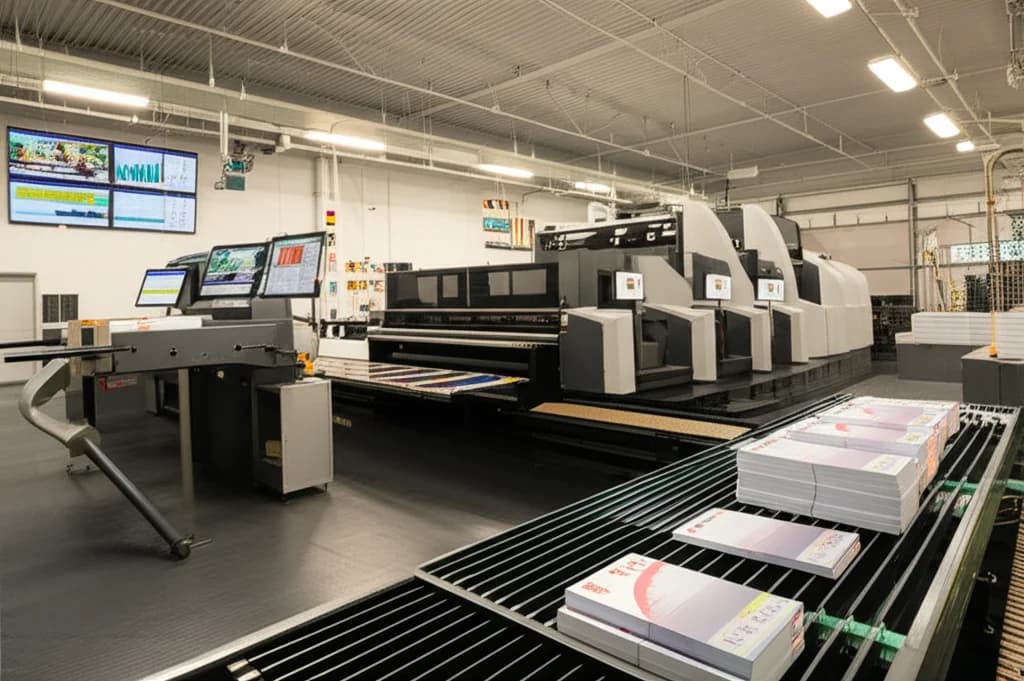
Walk into a modern print shop and you'll see the same presses, the same paper stacks, the same finishing equipment that's been there for years. What you won't see — but what's quietly changing everything — is the software running behind the scenes.
Artificial intelligence is reshaping commercial printing — not by replacing the presses, but by making every step around them faster, more accurate, and less dependent on manual intervention.
The Short Answer
AI in commercial printing automates prepress file checking, color calibration, defect detection, and job scheduling. The result: fewer errors, faster turnaround, lower waste, and more consistent quality — especially for high-volume and repeat jobs.
Here's how it actually works in practice — no hype, just what's real and shipping today.
1. Prepress Automation: Catching Errors Before They Cost You
Prepress has always been the bottleneck. A designer sends a file, and a prepress operator manually checks it: Are the fonts embedded? Is the resolution high enough? Is it CMYK? Are the bleeds correct? Is the spine width right for a 200-page book?
AI-powered preflight systems now handle this in seconds. Tools like Enfocus Switch, Callas pdfToolbox, and Esko's automation suite use machine learning to:
- Auto-detect and fix common file errors — missing fonts, RGB-to-CMYK conversion, low-res image flagging
- Classify incoming jobs by type — business cards, brochures, banners — and apply the correct preflight profile automatically
- Flag anomalies that rule-based systems miss, like a logo that's subtly different from the approved brand file
Real-world impact
A mid-size commercial printer processing 200 jobs/day reported that AI preflight reduced manual prepress intervention by 60% and cut file-related reprints by 40%. The prepress team shifted from error-catching to value-added work like color matching and proofing.
2. Color Management: Consistency Without Constant Tweaking
Color consistency is one of the hardest problems in printing. The same CMYK values can look different across presses, substrates, and even throughout a single print run as temperature and humidity shift.
Traditional approach: a skilled press operator eyeballs the output, pulls a sheet, compares it to a proof, and adjusts ink levels manually. This works — but it's slow, operator-dependent, and not scalable.
AI-driven color management systems — like those from ColorGATE, GMG, and X-Rite — take a different approach:
- Spectrophotometer feedback loops: Inline sensors measure color on every sheet. AI compares measured values to target values and adjusts ink delivery in real time — no operator needed.
- Predictive profiling: Instead of building new ICC profiles manually for every paper/ink combination, AI predicts optimal profiles based on historical data.
- Cross-press matching: AI can match color output across different press models — so a job that runs on Press A today looks identical when it runs on Press B next month.
For brand-sensitive work (think Coca-Cola red or Tiffany blue), this is transformative. You get Delta E values under 1.0 consistently, without burning half an hour of press time on makeready sheets.
3. Inline Defect Detection: Catching Problems at Press Speed
The worst moment in printing is discovering a defect after a 10,000-sheet run is finished. Misregistration, hickeys (small spots caused by debris), streaking, banding — these can ruin an entire job.
AI-powered inspection systems — from vendors like ISRA VISION, BST, and Lake Image Systems — use high-speed cameras and neural networks to:
- Inspect every single sheet at press speed (up to 15,000 sheets/hour)
- Classify defect types — distinguishing between a harmless paper fiber and a genuine print defect
- Trigger automatic sheet rejection — defective sheets are diverted before they reach finishing
- Learn from false positives — the system gets smarter over time, reducing unnecessary stops
Why this matters for you
If you're ordering 50,000 brochures, inline AI inspection means every single one has been checked — not just a random sample. Defect rates drop from the industry average of 2-5% to under 0.1%.
4. Job Scheduling and Imposition: Maximum Efficiency, Minimum Waste
A commercial printer might have 300 jobs in queue on any given day. Each job has different quantities, paper stocks, sizes, deadlines, and press requirements. Scheduling these optimally is a complex combinatorial problem — and humans are notoriously bad at combinatorial optimization.
AI scheduling systems optimize for:
- Ganging: Grouping small jobs together on the same sheet to minimize paper waste. AI can find optimal gang layouts that a human scheduler would miss.
- Press assignment: Routing jobs to the right press based on current load, capabilities, and maintenance schedules.
- Deadline optimization: Prioritizing urgent jobs without creating bottlenecks for other work.
- Substrate consolidation: Batching jobs that use the same paper stock to reduce changeover time.
The result is fewer press changeovers, less paper waste, and more jobs completed per shift. Some shops report 15-25% throughput increases after implementing AI scheduling — without adding any new equipment.
5. Predictive Maintenance: Fixing Presses Before They Break
Unplanned downtime is expensive. A commercial press that goes down mid-run can cost thousands of dollars in wasted materials, delayed jobs, and emergency repairs.
AI-powered predictive maintenance uses sensors on press components — rollers, bearings, ink delivery systems — to:
- Monitor vibration patterns and flag anomalies before a bearing fails
- Track ink system performance and predict when print heads or anilox rollers need cleaning
- Schedule maintenance windows during natural low-volume periods
This shifts maintenance from reactive ("the press just broke") to proactive ("replace this roller next Tuesday before it causes problems"). The financial impact is significant — unplanned downtime costs 3-5x more than planned maintenance.
What This Means If You're Buying Print
You don't need to understand the technical details of AI in printing. But you should know what to expect from a printer that's invested in these technologies:
Faster Turnaround
Automated prepress and smarter scheduling mean your job moves through the shop faster — often 1-2 days faster than shops relying on manual processes.
Fewer Reprints
AI preflight catches file errors before printing starts, and inline inspection catches defects during the run. Both reduce the chance of a costly reprint.
More Consistent Color
Automated color management means your brand colors match — run to run, press to press, month to month.
Competitive Pricing
Less waste and higher throughput translate to lower costs — savings that good printers pass on to customers.
The Limits of AI in Printing (What It Can't Do Yet)
AI isn't magic, and it hasn't replaced skilled press operators. Here's what it still can't do well:
- Subjective quality judgment: AI can detect measurable defects, but "does this look right?" still requires human eyes — especially for art reproductions, skin tones, and premium packaging.
- Complex finishing decisions: Die-cutting, foil stamping, embossing — these still require experienced operators who understand material behavior.
- Customer communication: Understanding what a client actually wants from a vague brief ("make it pop") remains firmly human territory.
The best print shops use AI as a tool that amplifies human expertise — not replaces it. The press operator who used to spend 30 minutes on color makeready now spends 5 minutes, and uses the saved time on the creative challenges that machines can't solve.
How First Global Graphics Uses Technology to Speed Up Your Jobs
At First Global Graphics in Irwindale, CA, we've invested in automated preflight, digital color management, and smart scheduling systems to deliver faster turnaround without compromising quality. Whether you're printing 500 brochures or 50,000 direct mail pieces, our production workflow is designed to catch errors early, maintain color consistency, and get your job out the door on time.
Ready to get started? Call us at (626) 960-4081 or request a quote online. We'll walk you through the process and get your project into production fast.
Frequently Asked Questions
How is AI used in commercial printing?+
AI is used in commercial printing for automated prepress file checking (preflight), real-time color management, inline defect detection, job scheduling optimization, and predictive equipment maintenance. These applications reduce errors, speed up production, and improve print quality consistency.
Does AI replace human press operators?+
No. AI handles repetitive, measurable tasks like color calibration and defect detection, but skilled press operators are still essential for subjective quality judgment, complex finishing operations, and customer communication. AI amplifies human expertise rather than replacing it.
Will AI in printing reduce costs for customers?+
Yes, in most cases. AI reduces paper waste through smarter imposition, cuts reprint rates through better preflight and inspection, and increases press throughput through optimized scheduling. These efficiency gains typically translate to faster turnaround and more competitive pricing.
What is AI-powered preflight in printing?+
AI-powered preflight uses machine learning to automatically check incoming print files for errors — missing fonts, wrong color mode, low resolution, incorrect bleeds — and either fix them automatically or flag them for review. It processes files in seconds instead of the minutes or hours required for manual checking.
How does inline defect detection work in printing?+
High-speed cameras photograph every printed sheet at press speed. AI neural networks analyze each image in real time, comparing it to the reference file. Defective sheets — those with misregistration, spots, streaking, or color shifts — are automatically rejected before reaching finishing.
Does First Global Graphics use AI in its printing process?+
First Global Graphics in Irwindale, CA uses automated preflight systems, digital color management, and smart scheduling to deliver faster turnaround and consistent quality. Call (626) 960-4081 or visit our website to request a quote.
Ready to start your print project?
Get a free quote or call us at (626) 960-4081