HP Indigo vs Offset Printing: Which Produces Better Quality for Your Budget?
HP Indigo vs offset printing — which delivers better quality? We break down color accuracy, substrate flexibility, cost thresholds, and when each technology wins for your print project.
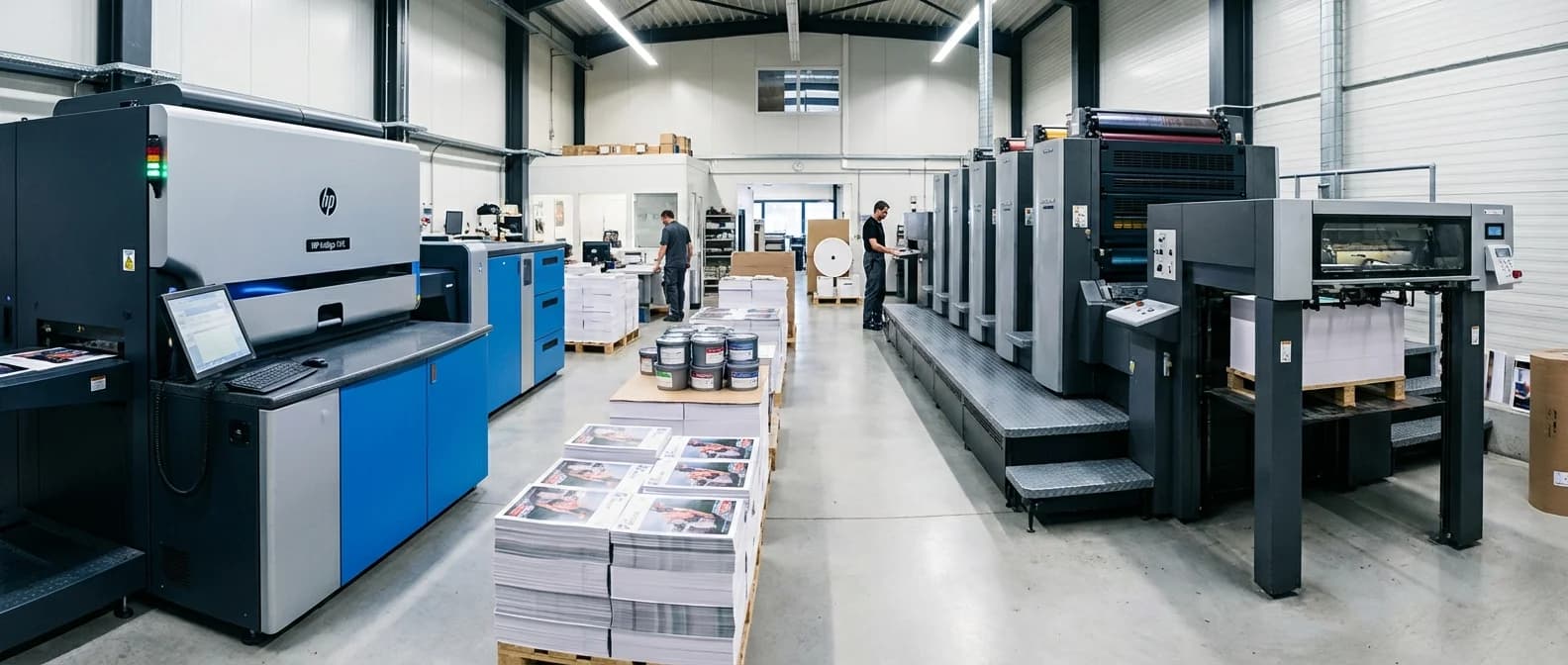
When clients ask us about print quality, the conversation almost always comes down to two technologies: HP Indigo and traditional offset lithography. Both can produce stunning results. But they're built for different use cases — and choosing the wrong one can mean paying too much or settling for output that doesn't match your brand standards.
This guide breaks down the real differences in quality, cost, and ideal applications so you can make a confident decision for your next project.
Quick Take
HP Indigo produces near-offset quality on short runs with exceptional color consistency and substrate flexibility. Offset wins on cost-per-piece at high volume and offers unmatched ink density for certain specialty finishes. For most runs under 500 pieces, Indigo is the better choice. Above 1,000, offset typically wins on price.
What Is HP Indigo Printing?
HP Indigo is a digital press technology that uses liquid electrophotography (LEP) — a process distinct from both conventional inkjet and toner-based laser printing. Instead of dry toner or aqueous ink, Indigo uses a liquid ink called ElectroInk, which is electrostatically charged and transferred through a heated blanket onto the substrate.
The result is an extremely thin ink layer (typically 1–2 microns) that sits on top of the substrate surface rather than soaking in. This is one reason HP Indigo output is often indistinguishable from offset to the naked eye.
Key Characteristics of HP Indigo
- Resolution: Up to 2400 × 2400 dpi, producing extremely sharp edges and fine detail
- Color gamut: Standard CMYK + optional Pantone-matched spot colors via additional ink stations
- Substrate range: Paper, coated stocks, labels, flexible packaging, synthetic materials, and more
- Run length: Economical from 1 to ~500–1,000 copies depending on format
- Variable data: Fully supported — each piece can be different at no cost penalty
What Is Offset Printing?
Offset lithography has been the backbone of commercial printing for over a century. It works by transferring ink from a metal plate to a rubber blanket, then from the blanket to the substrate — hence "offset." Each color requires its own plate, so a standard CMYK job requires four.
The process has a meaningful setup cost (plates, press makeready, ink mixing), but once running, it's extraordinarily efficient. At high volumes, the per-unit cost drops to a fraction of digital production.
Key Characteristics of Offset Printing
- Resolution: Typically 150–200 lpi in halftone, visually very sharp at normal viewing distances
- Color gamut: CMYK + unlimited Pantone spot colors, metallics, and specialty inks
- Substrate range: Most coated and uncoated papers; specialty substrates require UV or waterless offset
- Run length: Most cost-effective from ~500 to millions of copies
- Specialty finishes: Varnishes, aqueous coatings, UV coating, and foil stamping integrate naturally
Quality Comparison: The Real Differences
Color Accuracy
This is where HP Indigo surprises most people. Because ElectroInk is applied in a very thin, consistent layer, Indigo presses produce remarkably consistent color from sheet one to sheet ten thousand. There's no ink/water balance to manage, no dot gain drift, and no warming-up period that affects early sheets.
Offset, by contrast, requires press operators to carefully manage ink density and water balance. On a well-run offset press with an experienced operator, color accuracy is excellent — but it takes skill to maintain, and the first 50–100 sheets of a run are typically discarded during makeready.
| Attribute | HP Indigo | Offset |
|---|---|---|
| Color consistency run-to-run | Excellent (digital control) | Very good (operator-dependent) |
| Sheet-to-sheet consistency | Excellent | Excellent (once settled) |
| Pantone spot colors | Simulated (6–7 color station options) | True Pantone ink |
| Fine detail / text sharpness | Excellent (2400 dpi) | Excellent |
| Ink density / richness | Very good | Excellent (thicker ink film) |
| Metallic / specialty inks | Limited (Indigo Silver available) | Full range |
Ink Density and "Feel"
Experienced print buyers sometimes notice that offset printing has a slightly richer, more saturated appearance in solid coverage areas — particularly in deep blacks and dark blues. This comes from the thicker ink film that offset deposits compared to Indigo's ultra-thin ElectroInk layer.
For most projects — brochures, flyers, business cards, postcards — the difference is negligible. But for luxury packaging, high-end annual reports, or brand materials where ink density is part of the premium perception, offset may have an edge.
Substrates and Specialty Printing
HP Indigo has a significant advantage in substrate flexibility. It can print on materials that offset cannot easily handle: pressure-sensitive labels, flexible packaging films, synthetic stocks (like Yupo), and textured or embossed papers. This makes it the default choice for label printing, custom packaging, and niche substrates.
Offset, in its traditional sheet-fed form, is largely limited to paper and board stocks. UV offset expands this somewhat, but Indigo generally wins on versatility.
Cost Comparison: Where the Crossover Happens
The most practical question for most print buyers isn't "which is higher quality?" — it's "which gives me better value at my quantity?"
| Quantity | HP Indigo | Offset | Winner |
|---|---|---|---|
| 1–50 | $$ | $$$$ (setup cost prohibitive) | Indigo |
| 50–250 | $$ | $$$ | Indigo |
| 250–1,000 | $$–$$$ | $$–$$$ | Depends on format |
| 1,000–5,000 | $$$ | $$ | Offset |
| 5,000+ | $$$$ | $ | Offset (significantly) |
The crossover point varies by product and shop, but a useful rule of thumb for the Los Angeles area: under 500 pieces, Indigo is usually cheaper or competitive; above 1,000, offset starts winning clearly on price.
When to Choose HP Indigo
- Short runs (under 500): No plate setup means no minimum quantity penalty
- Variable data printing: Personalized direct mail, numbered certificates, event badges
- Labels and packaging: Indigo handles pressure-sensitive labels and flexible packaging that offset cannot
- Fast turnaround: No makeready means jobs can go to press same day
- Testing or proofing: Print 50 copies to test market response before committing to a large run
- Specialty substrates: Synthetic papers, PET films, metallic stocks
When to Choose Offset
- Large runs (1,000+): Setup cost amortizes quickly; per-piece cost drops dramatically
- True Pantone spot colors: Brand-critical colors that must match PMS standards exactly
- Specialty inks: Metallics, fluorescents, UV coatings, varnishes
- Premium collateral: Annual reports, luxury catalogs, high-end packaging where ink richness matters
- High-volume direct mail: Offset web presses handle millions of pieces efficiently
What We See at First Global Graphics in Irwindale
At First Global Graphics, we run both digital and offset jobs every day for clients across the San Gabriel Valley and greater Los Angeles area. Here's our honest take:
Most small business clients — restaurants, law firms, real estate agencies, event promoters — get better value from digital printing. Their runs are typically 100–500 pieces, they need quick turnaround, and the quality difference from offset is invisible at those quantities. We can have their job printed and ready for pickup in 24–48 hours.
Our corporate and agency clients with larger campaigns — direct mail drops of 10,000+ pieces, annual reports, trade show materials — almost always go offset. The economics are clear, and offset's ability to match Pantone colors precisely matters for brand consistency.
Not Sure Which to Choose?
Tell us your quantity, timeline, and budget — we'll recommend the right technology and give you an accurate quote. Serving Irwindale, Azusa, Covina, West Covina, Pomona, and all of the San Gabriel Valley.
Get a Free QuoteFrequently Asked Questions
Is HP Indigo quality as good as offset printing?+
For most applications, HP Indigo quality is visually indistinguishable from offset. The main differences are in ink density for solid coverage areas and true Pantone spot color matching — areas where traditional offset has a slight edge. For short runs, fast turnaround, and variable data, Indigo is often the better choice overall.
At what quantity does offset printing become cheaper than HP Indigo?+
The crossover depends on the format and shop, but a general rule of thumb is around 500–1,000 pieces for standard formats like brochures and flyers. Above 1,000 copies, offset becomes clearly more cost-effective due to lower per-sheet costs once setup is amortized.
Can HP Indigo match Pantone colors?+
HP Indigo can simulate most Pantone colors using its CMYK plus extended color station options, but it does not use true Pantone ink. For brand-critical Pantone matching where exact PMS accuracy is required, traditional offset with a dedicated Pantone ink station is more reliable.
Does First Global Graphics in Irwindale offer both HP Indigo and offset printing?+
Yes. First Global Graphics offers both digital and offset printing for clients in Irwindale, Azusa, Covina, West Covina, Pomona, and the greater Los Angeles area. Contact us to discuss which technology fits your project best.
Which printing method is better for labels and packaging?+
HP Indigo is generally superior for labels and flexible packaging because it can print on pressure-sensitive label stocks, PET films, and synthetic substrates that traditional offset cannot easily handle. It also excels at short-run label jobs where offset setup costs would be prohibitive.
How fast is HP Indigo turnaround compared to offset?+
HP Indigo jobs typically have faster turnaround because there is no plate-making or press makeready. Digital jobs can often go to press the same day files are approved. Offset jobs usually require at least 2 to 3 additional days for prepress and plate production.
Ready to start your print project?
Get a free quote or call us at (626) 960-4081